INSPECTION AND DIAGNOSIS
Before quoting a cleaning, the real state of the system
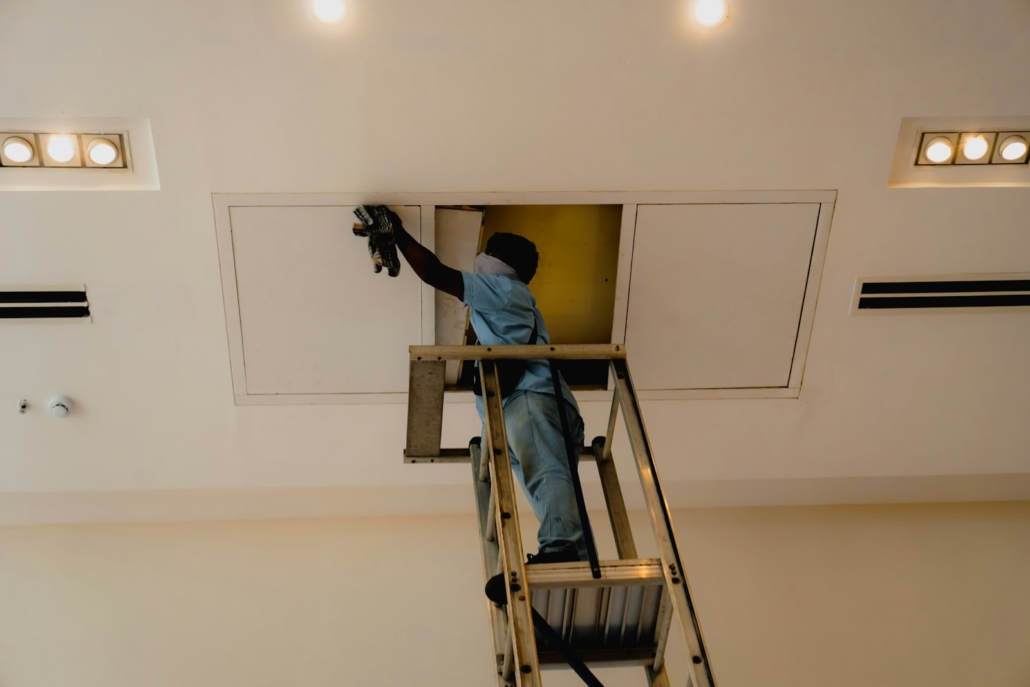
The inspection is the entry point: it documents the condition of the ductwork and what to do is decided on that basis.

01
Evidence: photographs and video of the inspected points.
02
Findings ordered by priority, written to be understood without being technical.
03
Frequency recommendation based on the real use of the building.
A cleaning quoted on a real state costs what it has to cost. Quoted blind, it is over- or under-estimated, and the difference shows up later, with the work already under way.
That is why the inspection report is the basis of any proposal and why it belongs to the client: it can be used to ask other providers for quotes and compare on the same data.
Industry references work on periodic inspection and cleaning when the inspection justifies it, not on a fixed calendar.
The inspection does not end in cleaning by default. The EPA does not recommend routine duct cleaning and asks for a reason. These are the situations that are checked and what is recommended in each.
| What is found | What is recommended | Basis |
|---|---|---|
| Substantial visible mold inside hard-surface (sheet metal) ducts | Clean and correct the cause of the moisture, otherwise the mold returns. | EPA |
| Mold on internal fiberglass insulation | Remove and replace the material. Cleaning is not enough. | EPA |
| Ducts infested with vermin, rodents or insects | Clean and remediate. | EPA |
| Ducts clogged with excessive dust and debris | Clean. | EPA |
| Particles coming out of the supply registers | Clean. | EPA |
| Standing water or a blocked drain in the condensate pan | Correct the drain before cleaning. | EPA, chapter 2 |
| Water intrusion or a leak in the system | Assess and correct the source. Wet insulation cannot be effectively cleaned and should be replaced. | EPA |
| Construction or renovation near the system | Inspect the condition. The EPA advises sealing the registers during the work so dust does not get in. | EPA |
| Persistent damp smell when the unit starts | Check the pan, the coil and the drain. | Limpieza de Ductería criterion |
| None of the above | Do not clean by calendar. Document the condition and define when to inspect again. | EPA and Zuraimi, 2010 |
The camera inspection makes it possible to see inside the accessible sections without opening the whole system and leaves photographs comparable with those of the later verification. When the report finds none of these situations, it says so and proposes when to inspect again.
How is the frequency decided?
With the inspection. It depends on occupancy, the type of activity, the state of the filtration and the condensation history of the system. Industry references work on periodic inspection and cleaning when the inspection justifies it, not on a fixed calendar.
What happens with sections without access doors?
They cannot be cleaned or verified. They are recorded in the report, with the recommendation to install access doors.
Can work be done with the building occupied?
Yes. Work is done by sectors and at an agreed schedule, with filtered vacuum extraction so nothing is dispersed into the occupied space.
Does the report help justify the expense to a board?
It is written to be understood without being technical, with photographs of the before and after and findings ordered by priority.
Is the report ours?
Yes. You can use it to ask for quotes from whoever you want, including other providers.
Do you work on installations built by someone else?
Yes, it is the usual case. The first inspection documents the condition in which the system is received.
Is this the same as cleaning kitchen ducts?
No. In air conditioning ductwork, dust and microbial growth are removed and what is at stake is air quality. In kitchen ducts, grease is removed and the risk is fire. The procedure, the equipment and the frequency change.
How much does it cost?
It depends on the size of the system, its condition and the accessible sections. It is quoted on the result of the inspection.
The four advantages refer to what the report contains and the decision it allows. None describes effects on the people who occupy the building.
| What is gained | What it involves | Reference |
|---|---|---|
| A photographic baseline | The first inspection fixes how the system stands on a given date, with photos and video of the points reviewed. Any later comparison starts from those images and not from anyone’s memory. | Photo and video evidence in the report. |
| Findings sorted for non-technical readers | Findings are ranked by priority and written in plain language, each with the image that backs it, so a board without technical training can follow them. | Report section on findings and recommendations. |
| An outcome other than cleaning | If none of the situations the EPA considers appears, the report says so and proposes when to inspect again, so not cleaning is also a valid result of the inspection. | Decision table on this page and EPA guidance. |
| A report that works with any provider | Because the report belongs to the client, another provider can quote on the same documented condition, and the management compares proposals from a single starting point. | Report ownership commitment, described on the method page. |
Three isolated measurements show why the inspection looks beyond the grille. They are individual cases and are cited with their limit, not as sector averages.
| Data point | Source | Scope |
|---|---|---|
| An air unit with no visible dirt had, in the 1992 measurement, between 10⁵ and 10⁶ viable bacteria per cm² on its coil fins, and the water in its pan held between 10⁵ and 10⁷ per ml. That is why the camera reviews the unit and not only the grille. | Hugenholtz and Fuerst, 1992 | A single system measured in 1992, not a general figure or an average. |
| In a study of 25 operating theatres, 26% of the air system filters showed fungi. The condition of the filtration is therefore among the points checked in any building. | Kelkar et al., 2005 | One-off hospital study in operating theatres, not an average for other buildings. |
| Air handling unit filters at nine locations of a university in Singapore collected, after twelve weeks, between 1.1 and 41 ng of total DNA per cm², a wide gap between one point and another on the same campus. That spread explains why a frequency is not copied from one building to another. | Luhung et al., 2017 | A single campus. The filter was measured, not the effect of cleaning. |
The review points are those on the page, and this explains what each one means within the report. None is read as an effect on people, only as the condition of the system.