THE SERVICE
Air conditioning duct cleaning
Eight-phase method, with camera verification before and after and a record of the sections without access.

Cleaning ductwork is not running a machine through the ducts: it is a procedure with an inspection at the start, a verification at the end and a report that supports it. This page describes each phase, the equipment involved and what is documented.
| Phase | What is done and with what | What is documented |
|---|---|---|
| 1. Preliminary inspection | Walk-through with an inspection camera of the accessible sections, from the access points. | Photographs and video of the initial condition, with the location of each point. |
| 2. Work plan | Sectorization of the system by zones and definition of the schedule with the building management, to work with the building occupied. | Scope, date and personnel involved. |
| 3. Mechanical cleaning | Mechanical brushing of the inside of the duct with filtered vacuum equipment, to remove deposits without dispersing them into the occupied space. | Sections cleaned. |
| 4. Grilles and diffusers | Removal and cleaning of the grilles and diffusers of the intervened sector. | Elements intervened. |
| 5. Air handling unit | Cleaning of the air handling unit, the coil, the condensate pan and the drain. | Findings on the unit and the drain. |
| 6. Disinfection | Application of a product suitable for ducts on the surfaces already cleaned. | Product applied and sectors treated. |
| 7. Verification | Second camera inspection at the same points as the first. | Photographs and video of the after, comparable with the before. |
| 8. Report | Delivery of the technical report of the intervention. | Scope, evidence, sections without access and frequency recommendation. |
If the system does not have enough access doors, there are sections that cannot be cleaned or verified. Those sections are recorded in the report and installing access doors is recommended so that the next intervention can reach them.
This is stated in writing instead of presenting a partial cleaning as complete.
Cleaning the duct and leaving the condensate pan with standing water leaves the source of moisture untouched, and the EPA states that if the cause is not corrected the mold returns. That is why the air handling unit, the coil and the drain are part of the intervention and not a separate service.
What is found in that unit is recorded in the report, together with a recommendation on the drain when appropriate.
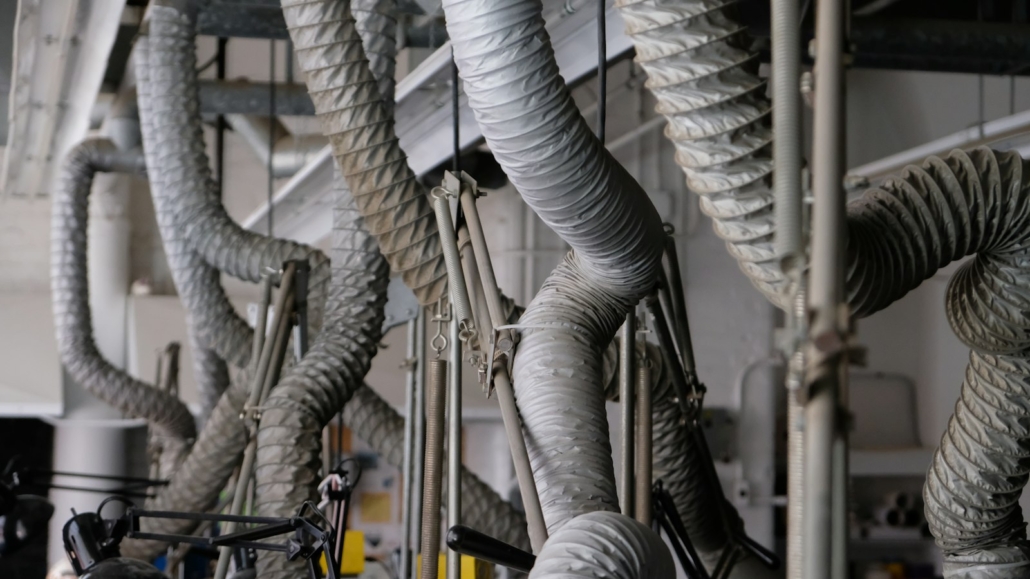
Work is organized by sectors and at the schedule agreed with the building management. Filtered vacuum extraction avoids dispersing what is removed into occupied spaces.
Sources: Ahmad et al., 2001, EPA and EPA, chapter 3.
Each row describes something that comes out of a phase of the method, not an expectation about the people who occupy the building. The site attributes no health effect to any of them.
| What is gained | What it involves | Reference |
|---|---|---|
| A scope that can be discussed before work begins | The split into zones and working hours is put in writing before the mechanical cleaning, so the management knows which sector is being worked on, when, and with which staff. | Work plan phase. |
| A before and an after that can be compared | Because the second inspection returns to the points of the first, the difference is seen image against image and does not depend on how whoever did the work tells it. | Preliminary inspection and verification phases. |
| Grilles and diffusers with their own record | The elements that are removed and cleaned in each sector appear in the report, so they are not confused with what was only cleaned from inside the branch. | Grille and diffuser phase. |
| A partial cleaning that is declared partial | When a section has no access door, the report records it as neither cleaned nor verified and suggests installing doors, instead of presenting the job as complete. | Report phase and the section on areas without access. |
The three references set limits rather than promises. Each figure comes with its source and scope, and none is presented as an expected result in a particular building.
| Data point | Source | Scope |
|---|---|---|
| In a study of newly installed ducts, mechanical brushing and compressed air removed 86 to 99% of the dust in the laboratory and 75 to 94% at the building site. Oily surfaces were not cleaned well by any method, something only an inspection can reveal before choosing how to clean. | Holopainen et al., 2003 | New ducts with building-site dust, unlike a network that has been in operation for years. |
| When the fiberglass of a lining or a duct shows mold, the EPA recommends replacing it, since cleaning does not stop the mold from reappearing. In the report, what is cleaned and what is proposed for replacement appear separately. | EPA, cleaning air ducts at home | Applies to internal linings and fiberglass ducts, not to sheet-metal ones. |
| In residential ductless units of the minisplit type, high-pressure washing cut the internal fungal load by more than 99%, but a year later, in 17 units, it had returned to its earlier level. A cleaning describes the state at one moment, not a permanent one. | Shiraishi et al., 2023 and Shiraishi et al., 2026 | A different type of equipment, without ducts. Cited as context for recontamination. |
These observations accompany the method without adding steps. They are the notes from which the final report describes the system as it was found and not as it was assumed.